


What OCD Actually Looks Like: Beyond Handwashing and Checking

by Megan Rose, LMHC, BICBT-CC
OCD is such a tricky illness; it isn’t just handwashing and/or checking. OCD consists of two main parts: obsessions and compulsions. Obsessions are triggered by something called intrusive thoughts. In reality, intrusive thoughts can take the form of thoughts, images, urges, impulses, ideas, sensations, and memories. People with OCD become afraid of what these obsessions mean.
“Am I going to hurt my child?”
“Did I just hit someone while driving?”
“What if I cause my loved one to die or get horribly hurt?”
“What if…?”
“Could I be someone who…?”
These thoughts lead to fear.
Fear has a very specific job: to keep us alive!
Human brains are biologically hardwired for survival. For example, if I see a bear while on a walk, the alarm system in my brain goes off and tells me to fight, flee, or freeze. The alarm has done its job, the threat has passed, and the fear subsides. My body can then return to an emotionally regulated state.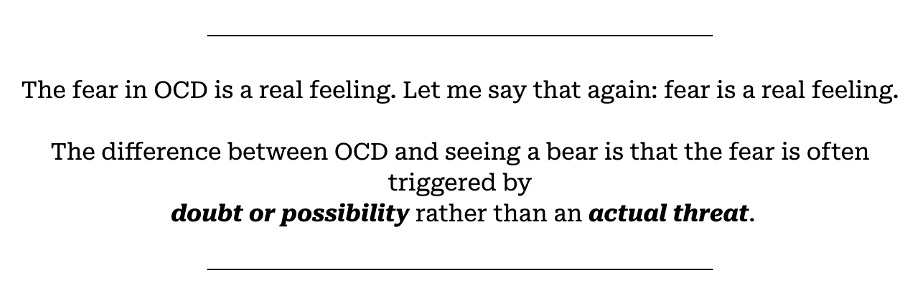 Our brains quickly learn that compulsions temporarily reduce distress and create the possibility of returning to a more emotionally regulated state. This is called negative reinforcement. Over time, we begin to associate compulsions with relief, and they start to feel like the best way to stop the fear. However, the relief is temporary, and the cycle continues. Over time, compulsions can become more time-consuming and interfere with daily functioning. OCD can even contribute to depression and other mental health struggles.
Compulsions are not just handwashing or checking. Other common compulsions include:
- Rumination
- Avoidance
- Reassurance seeking
- Praying
- Confessing
- Mental checking
- And many more
There are many common presentations of OCD. Some of them include:
- Harm
- Postpartum and perinatal
- Sexual
- Just-right/perfectionism
- Symmetry
- Existential
- Sensorimotor
- Scrupulosity
- False memory
- Magical thinking
Compulsions can look very different depending on the presentation. A common compulsion associated with Contamination OCD is handwashing; but someone with Harm OCD might worry that something bad will happen to another person unless they neutralize the thought. An individual with Just Right OCD might continue to redo a task until it ‘feels’ right.
Often, compulsions don’t make logical sense, even to the person experiencing them. Trying to understand, explain, or make sense of why a compulsion feels necessary can actually make things worse. This is because OCD thrives on doubt, uncertainty, and the need to feel certain. The more we try to reason our way out of OCD, the more we can get pulled into the cycle.
OCD is so much more than checking and handwashing. If you or someone you know seems to recognize this OCD cycle, reach out for help! MWR Counseling has trained professionals who can help assess and treat OCD, using therapies such as ERP and I-CBT that are specific to OCD treatment.
You are not alone – there is help.
Interested in learning more? Check out our blogs:
Why Reassurance Can Make OCD Worse (Even When It Feels Helpful!)
The Difference Between OCD and Anxiety
How to Support Someone with OCD, Without Reinforcing the Cycle